Mullet Haircut Men: 30+ Modern Styles, Fades & Styling Tips
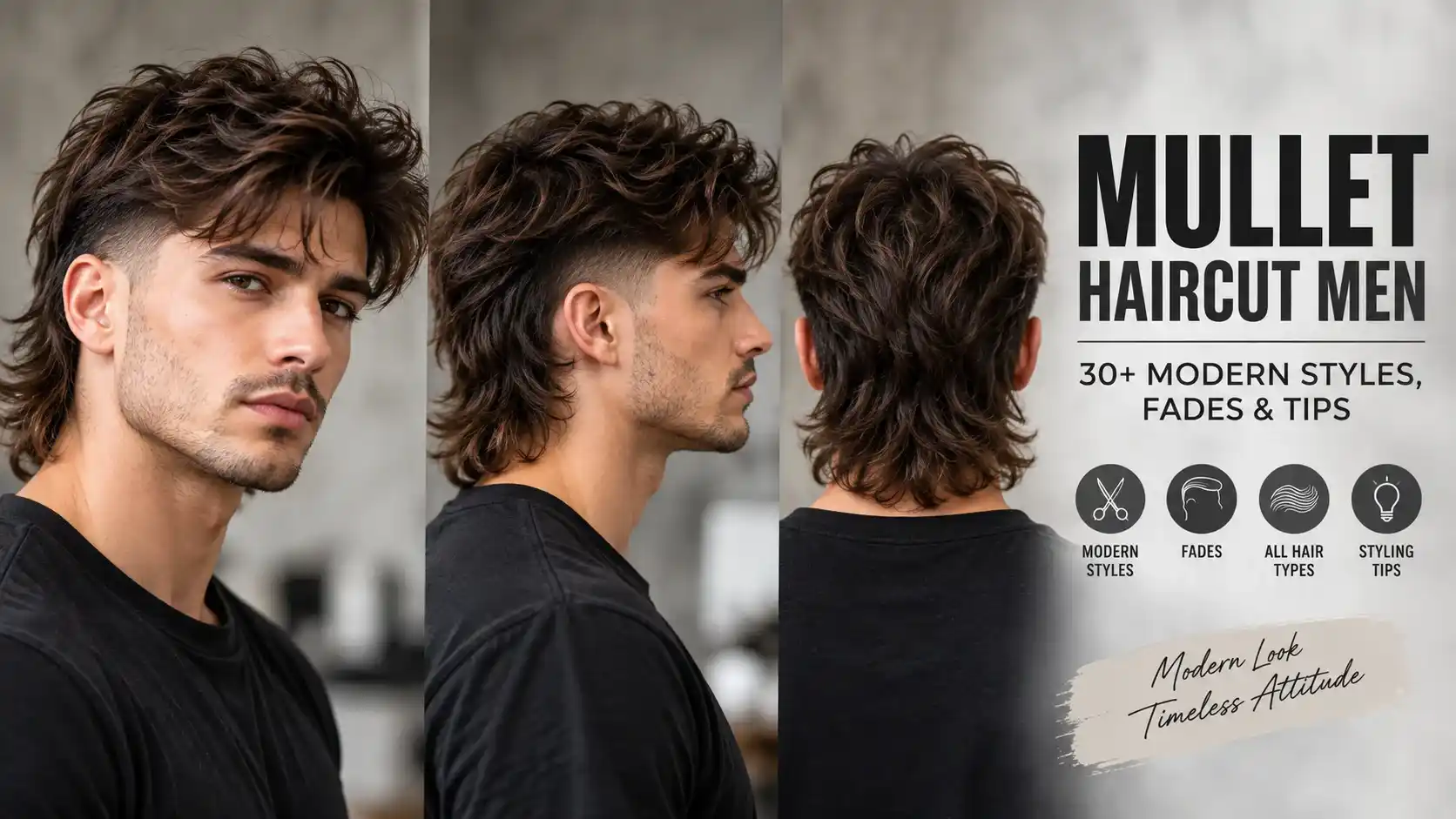
The mullet haircut men is no longer limited to the exaggerated 1980s look most people associate with the word. Today’s versions can be short and subtle, heavily textured, curly, wavy, faded, shaggy, or deliberately bold.
What makes the modern mullet different is not simply having longer hair at the back. The haircut is built around how the top, sides, temples, crown, and back work together. A low taper creates a very different result from a burst fade, while a short nape creates a completely different impression from a long, flowing back.
That gives you plenty of room to personalize the style.
Whether you’re considering a modern mullet haircut men, a short mullet, a fade mullet, a curly mullet, or a longer old-school version, this guide will help you understand the differences and choose a version that actually fits your hair and lifestyle.
What Is a Mullet Haircut Men?
A mullet is a haircut in which the hair at the back is kept longer than the hair around the front and sides.
That’s the basic definition, but it doesn’t tell you what makes one mullet look great and another look awkward.
The finished appearance depends on several variables:
- Back length: how far the hair extends down the neck
- Side treatment: scissors, taper, low fade, mid fade, or burst fade
- Top length: how much hair is available for texture and styling
- Layering: how the top transitions into the back
- Texture: straight, wavy, curly, or coily
- Contrast: how dramatic the difference is between the sides and back
- Maintenance: how frequently you are willing to visit a barber
This is why two people can both have a “mullet” while their haircuts look completely different.
A classic mullet usually creates a stronger visual separation between the shorter front and sides and the longer back. A modern mullet haircut men generally uses cleaner side work, softer or more intentional layering, texture, and more controlled length.
The result can be subtle enough for everyday wear or dramatic enough to become the defining feature of your appearance.
Classic Mullet vs. Modern Mullet
The classic mullet haircut men is strongly associated with the 1970s and especially the 1980s. Its recognizable formula was shorter hair toward the front and sides combined with significant length at the back.
The modern version keeps that basic silhouette but changes the execution.
Classic mullet
- More obvious length at the back
- Stronger contrast
- Often fuller sides
- More pronounced retro appearance
- Frequently associated with 1980s styling
Modern mullet
- Cleaner sides
- More controlled back length
- Textured or layered top
- Tapers and fades are common
- Softer transitions are possible
- Easier to adapt to different hair textures
The important point is that modern does not automatically mean short.
You can have a relatively long modern mullet if the shape, layers, and side treatment are deliberate.
How to Choose the Right Mullet
Before choosing a photo from Pinterest or Instagram, make five decisions.
1. Decide How Much Back Length You Want
This is probably the biggest decision.
Short back
The hair reaches around the upper neck.
Good for: first-time mullet wearers, conservative styles, and people who want less commitment.
Medium back
The hair extends farther down the neck but remains clearly above the shoulders.
Good for: the classic modern-mullet appearance.
Long back
The back has significant length and movement.
Good for: people who want a stronger statement or already have long hair.
If you’re unsure, medium length is usually the safest starting point because you can shorten it later without having to grow it out again.
2. Choose Your Side Treatment
The sides can completely change the personality of a mullet.
Scissor-cut sides
This keeps more natural weight and produces a softer result.
Choose this if: you don’t want a very obvious fade.
Low taper
A low taper cleans up the area around the sideburns and neckline while preserving more hair around the sides.
Choose this if: you want a subtle, wearable modern mullet.
Low fade
A low fade creates more contrast while keeping the transition relatively low.
Choose this if: you want a cleaner appearance without making the haircut extremely aggressive.
Mid or high fade
Removing more hair from the sides increases the contrast between the top and back.
Choose this if: you want the mullet to be a major part of your look.
Burst fade
The fade curves around the ear while preserving length behind it.
This is particularly effective when you want the back to remain visually full while keeping the area around the ear clean.
Choose this if: you want a noticeable, high-contrast modern mullet.
3. Think About Your Hair Texture
Your natural texture should influence the haircut rather than being treated as an inconvenience.
Straight hair
Straight hair makes the shape very visible.
The downside is that it can sometimes look flat, especially when the top and back have little natural movement.
Ask your barber for layers and texture rather than simply leaving everything one length.
Wavy hair
Wavy hair is naturally suited to relaxed mullets because the movement helps connect the top with the longer back.
A medium-length wavy mullet can look particularly good without requiring heavy daily styling.
Curly hair
Curly hair creates volume and character throughout the shape.
The important thing is to cut according to the curl pattern. The length that looks right when wet may become considerably shorter once the curls dry.
Coily or highly textured hair
A mullet can also be adapted to highly textured hair. The side treatment and the amount of length retained at the crown and back become particularly important because texture can dramatically change the final silhouette.
The best approach is to show your barber examples with a similar texture rather than assuming a reference photo will translate exactly to your hair.
4. Consider Your Face Shape
Face shape shouldn’t be treated as a strict list of rules.
Hair volume, density, forehead size, jaw width, and personal style all matter.
Still, face shape can help you decide where you want volume.
Mullet for a Round or Chubby Face
If your face is relatively round, excessive width around the sides can make the face appear wider.
A better approach is usually:
- Keep the sides relatively controlled
- Add some height or texture on top
- Maintain enough length in the back to create vertical movement
- Avoid excessive bulk directly around the widest part of the face
A low fade or low taper mullet can therefore be a more flattering starting point than a very full-sided version.
Mullet for an Oval Face
An oval face gives you considerable flexibility.
Short, medium, long, faded, textured, curly, and shaggy versions can all work depending on the proportions of the haircut.
Mullet for a Square Face
A square face already has strong angles through the jaw and forehead.
A textured or layered mullet can complement those proportions, while softer layering can make the overall appearance less rigid.
Mullet for a Long Face
Be careful about stacking excessive height on top.
A longer back can work, but adding substantial vertical volume at the crown as well can make the face appear even longer.
30+ Mullet Haircut Styles for Men
Now comes the fun part.
Rather than treating every variation as completely separate, it helps to think of mullets as combinations of length + side treatment + texture.
1. Modern Mullet Haircut Men
The standard modern mullet keeps the sides controlled, gives the top some texture, and leaves visible length at the back.
It is the best starting point if you like the concept but aren’t sure how extreme you want to go.
- Best for: most hair types.
- Ask for: textured top, controlled sides, layered medium-length back.
2. Short Mullet Haircut
A short mullet haircut for men preserves the recognizable shape without allowing the back to become very long.
It is one of the easiest versions for someone trying a mullet for the first time.
The shorter back also makes the haircut less visually dramatic and easier to grow out if you decide the style isn’t for you.
Best for: straight, wavy, and moderately curly hair.
3. Medium-Length Mullet
The medium mullet sits between the short modern version and the traditional long style.
This is arguably the most versatile length because there is enough hair at the back to create movement while the haircut remains relatively easy to manage.
Best for: men who want a clearly recognizable mullet without going extreme.
4. Long Mullet Haircut
A long mullet haircut men puts the back at the center of attention.
The extra length works particularly well when the hair has natural waves or curls because the movement prevents the back from appearing like a simple strip of hair.
If your hair is straight, layering becomes especially important.
5. Low Fade Mullet
The low fade mullet haircut men is one of the easier ways to make the style cleaner without removing too much hair.
Because the fade remains low, more weight is preserved higher on the sides.
Choose it if: you want a modern appearance without an extremely aggressive contrast.
6. Burst Fade Mullet
The burst fade is one of the strongest pairings with a mullet.
Instead of fading evenly around the entire side of the head, the fade expands around the ear while preserving the longer hair behind it.
This creates a distinctive transition from the clean side area into the fuller back.
Best for: men who want obvious contrast and a more expressive haircut.
7. Curly Mullet
A curly mullet haircut men can look dramatically different from the same haircut on straight hair.
The curls naturally increase volume, particularly around the crown and back.
Don’t automatically ask your barber to make the back extremely long. Curly hair can appear much longer when stretched than it does in its natural state.
8. Wavy Mullet
Wavy hair is almost tailor-made for a relaxed mullet.
The natural bends in the hair create movement through the top and back without requiring excessive styling.
A wavy modern mullet works especially well when the layers are allowed to flow rather than being cut into rigid steps.
9. Straight-Hair Mullet
Straight hair creates a sharper outline.
That can be a strength, but it also means mistakes in the shape are more visible.
For a mullet haircut men with straight hair, ask for texture through the top and back if you want a more modern appearance.
A matte styling product can then separate the layers without making the hair look overly polished.
10. Wolf Mullet
The wolf mullet haircut men sits somewhere between a mullet and a wolf cut.
It usually has more layers, more movement, and a less rigid transition than a traditional mullet.
The distinction is useful:
- Mullet: stronger emphasis on the longer back.
- Wolf cut: more evenly distributed shaggy layering.
- Wolf mullet: combines elements of both.
This is a good choice if you want texture and movement more than a sharply defined silhouette.
11. Textured Mullet
Texture can completely change the personality of the haircut.
Instead of leaving the top smooth, the barber uses layering and texturizing techniques to create separation.
This is particularly useful for straight or thick hair that otherwise tends to sit heavily.
12. Soft Mullet
A soft mullet haircut men reduces the contrast between the shorter areas and the back.
Instead of creating an extremely obvious transition, the haircut uses softer layers and a less aggressive side treatment.
This is one of the best options if you like the mullet shape but don’t want people to notice the haircut before they notice you.
13. Subtle Mullet
The subtle mullet takes that idea even further.
The back is only slightly longer than the rest of the haircut, creating a hint of the classic shape rather than a dramatic statement.
Best for: first-time wearers, conservative environments, and men who want a low-commitment version.
14. Messy Mullet
The messy mullet intentionally embraces imperfect texture.
Instead of creating neat, uniform layers, the hair is styled with separation and movement.
This works particularly well with naturally wavy or thick hair.
15. Shaggy Mullet
The shaggy mullet incorporates more layers throughout the haircut.
Compared with a clean fade mullet, it feels more relaxed and rock-inspired.
It is especially effective on hair that already has natural movement.
16. Baby Mullet
A baby mullet is essentially a very short, understated version.
The back has enough extra length to suggest a mullet without creating a pronounced tail.
This is an excellent choice if you want to experiment before committing to a more dramatic version.
17. Mini Mullet
The mini mullet follows the same philosophy but can have slightly more definition through the back.
Think of it as the middle ground between a textured short haircut and a recognizable mullet.
18. Classic 80s Mullet
If you actually want the retro look, don’t be afraid of it.
The 80s mullet haircut for men generally uses more length and volume and creates a much stronger contrast than many contemporary versions.
The key difference is that this is intentionally retro rather than accidentally outdated.
19. Old-School Mullet
An old-school mullet leans heavily into the original aesthetic.
It can work especially well when paired with vintage-inspired clothing and styling rather than being mixed with an ultra-modern fade.
20. Country Mullet
The country mullet typically keeps substantial length in the back while maintaining a cleaner top and sides.
The overall effect can range from relatively traditional to highly modern depending on whether you use a taper, fade, or scissors.
21. Flow Mullet
The flow mullet emphasizes movement rather than sharp contrast.
The back is allowed to grow and flow naturally while the top and sides remain controlled enough to preserve the mullet shape.
This version works particularly well with naturally wavy hair.
22. Mohawk Mullet
The mohawk mullet combines the central emphasis of a mohawk with the longer back of a mullet.
It is considerably more dramatic than a subtle or low-taper version.
Choose it only if: you’re comfortable making the haircut a major part of your appearance.
23. Fashion Mullet
A fashion mullet is less about following a single traditional formula and more about experimenting with proportions.
It might include unusual layering, fringe, color, extreme texture, or an unconventional fade.
This is where the mullet becomes a creative haircut rather than simply a hairstyle category.
24. Clean Mullet
A clean mullet haircut for men focuses on precision.
The sides are carefully tapered or faded, the neckline is controlled, and the back is shaped rather than allowed to grow randomly.
This is a good option if you want a mullet that looks intentional in professional and casual settings.
25. Mullet With Fringe
Adding a fringe changes the balance of the haircut by bringing more visual weight toward the front.
A textured fringe can work particularly well with a shaggy or wolf-inspired mullet.
26. Taper Mullet
The taper mullet is more conservative than many fade versions.
Rather than removing a large amount of hair from the sides, the barber gradually cleans up the edges.
Best for: men who want a modern mullet that remains relatively understated.
27. High-Contrast Mullet Fade
A stronger fade makes the longer back appear even longer because of the contrast.
This can produce an impressive visual effect, but it also makes the haircut more noticeable as it grows out.
Best for: men who don’t mind frequent barber visits.
28. Curly Burst-Fade Mullet
This combines three strong elements:
- Natural curls
- Burst fade
- Longer back
The curls provide volume while the burst fade creates separation around the ear.
The result can be particularly striking because the texture does much of the styling work naturally.
29. Medium Modern Mullet for Straight Hair
This is a useful middle ground for men who want the modern shape without a very dramatic fade.
Keep the sides controlled, add texture through the top, and maintain moderate length at the back.
30. Long Shaggy Mullet
This version pushes the haircut toward the wolf-cut/shag end of the spectrum.
The layers become more visible, the back becomes more fluid, and the overall shape looks less geometric.
Best for: thick, wavy, or naturally textured hair.
Which Mullet Should You Choose?
If you’re overwhelmed by all the variations, start here.
| If you want… | Consider |
|---|---|
| A safe first mullet | Short or subtle mullet |
| A clean modern look | Low taper or low fade mullet |
| Maximum contrast | Burst or higher fade |
| Natural texture | Wavy or curly mullet |
| A messy fashion look | Shaggy or wolf mullet |
| Retro style | Classic or 80s mullet |
| Long flowing hair | Long or flow mullet |
| Minimal commitment | Baby or mini mullet |
| Professional-friendly option | Soft or taper mullet |
| A bold statement | Mohawk or high-contrast mullet |
The Mullet Decision Formula
Here’s a simpler way to choose your haircut:
Your ideal mullet = desired back length + side treatment + natural texture + maintenance tolerance
For example:
Straight hair + low maintenance
Try:
Short/medium mullet + low taper + textured top
Curly hair + bold style
Try:
Medium/long mullet + burst fade + natural curls
Wavy hair + relaxed appearance
Try:
Medium flow mullet + soft taper + layered back
First-time mullet
Try:
Short/medium subtle mullet + low taper
Retro enthusiast
Try:
Long classic mullet + fuller sides + substantial back length
This approach is more useful than simply choosing the haircut with the coolest photograph because the same haircut can behave very differently on different heads of hair.
How to Style a Mullet Haircut for Men
Knowing how to style a mullet haircut for men depends heavily on your hair texture.
For Straight Hair
- Start with damp hair.
- Apply a lightweight volumizing or texturizing product.
- Blow-dry the top upward and slightly backward.
- Use your fingers to separate the layers.
- Shape the back so it follows the natural direction of the hair.
- Finish with a small amount of matte paste or clay if additional definition is needed.
The objective isn’t to make every strand perfectly controlled.
A little separation usually makes a modern mullet look more natural.
For Wavy Hair
Don’t fight the natural wave.
Apply a lightweight styling product while the hair is damp and allow the waves to form naturally.
If using a diffuser, keep the airflow controlled so you don’t turn the hair into a frizzy mass.
For Curly Hair
Use a curl-friendly product and work it through damp hair.
Scrunch the curls rather than aggressively brushing them.
Allow the hair to dry naturally or use a diffuser.
The goal is defined texture rather than maximum volume everywhere.
For a Messy Mullet
Use a small amount of matte paste or texture product.
Work it through the top with your fingers and lightly separate the longer back.
Don’t overwork it.
The entire point of a messy mullet is that it shouldn’t look meticulously constructed.
How to Ask Your Barber for a Mullet
This is one area where many hairstyle articles are surprisingly vague.
Don’t just show a barber a photograph and say:
“I want this.”
Explain the four things that matter.
Tell them:
1. How long you want the back
For example:
“Keep the back around the upper neck.”
or:
“I want the back to reach the collar.”
2. How you want the sides treated
For example:
“Keep the sides soft with a low taper.”
or:
“I want a burst fade around the ears.”
3. How much texture you want
For example:
“Keep the top textured and layered rather than blunt.”
4. How dramatic you want the transition
For example:
“I want the mullet to be noticeable, but not extremely disconnected.”
A complete barber request
If you want a balanced modern version, you could say:
“I’d like a medium-length modern mullet. Keep the back around the upper neck with soft layers, give me a low taper around the sideburns and neckline, and add texture through the top. I want the transition to look intentional but not overly disconnected.”
That’s much more useful than simply saying “modern mullet.”
What Can Go Wrong With a Mullet?
This is something worth understanding before getting the haircut.
The back is too thin
If too much weight is removed from the back, the hair can look like a thin tail rather than a deliberate mullet.
Solution: Keep enough density and use layers strategically.
The fade is too high
A high fade can create extreme contrast.
That isn’t necessarily bad, but if you wanted a softer haircut, you may regret removing that much hair.
Solution: Start lower if you’re unsure.
The sides are too bulky
Too much weight around the sides can make the haircut look closer to an old-school mullet.
Solution: Use a taper, fade, or controlled scissor work.
The top has no texture
Straight or thick hair can become heavy when the top is left too uniform.
Solution: Add appropriate layers and texture.
The back is too long for the rest of the haircut
Long hair isn’t automatically a better mullet.
The back needs to relate visually to the top and sides.
Solution: Choose length based on the overall silhouette rather than simply asking for “long.”
How Often Should You Maintain a Mullet?
Maintenance depends heavily on the side treatment.
A fade mullet generally requires more frequent barber visits because the clean transition around the sides becomes less defined as the hair grows.
A soft, shaggy, or longer mullet can be more forgiving.
A useful way to think about it is:
The cleaner the sides, the more often you’ll notice regrowth.
If you want a haircut that still looks intentional after several weeks, a taper or softer side treatment may be a better choice than an extremely tight fade.
How Long Does It Take to Grow a Mullet?
If you’re starting with short hair, the back needs time to develop enough length to create the characteristic silhouette.
Don’t make the mistake of judging the haircut during the awkward stage.
During the growing process, your barber can continue shaping the sides and top while allowing the back to gain length.
If you’re specifically trying to grow a long mullet, communicate that goal before your haircut. Otherwise, a barber may remove length from the back that you actually wanted to preserve.
Can You Wear a Mullet to Work?
It depends on the workplace and how conservative the version is.
A subtle mullet with a low taper is considerably less conspicuous than a long mohawk mullet with a high fade.
If your workplace has conservative grooming expectations, consider:
- Shorter back length
- Low taper
- Controlled layers
- Natural color
- Less extreme contrast
The haircut can still have the recognizable mullet shape without becoming the first thing people notice.
Is the Mullet Haircut Still in Style in 2026?
Yes, but the interesting part is how the style has changed.
Current men’s hairstyle coverage continues to feature modern mullets in combinations with fades, tapers, curls, waves, shaggy layers, and wolf-cut influences. Current broader hair-trend coverage also continues to highlight textured, lived-in shapes rather than highly rigid styling.
That means the question isn’t really whether “the mullet” is in style.
The better question is:
Which version of the mullet fits you?
A soft taper mullet and an exaggerated 1980s mullet may share the same basic structure, but they communicate completely different styles.
Mullet vs. Wolf Cut: What’s the Difference?
The two styles overlap, which is why the term wolf mullet has become common.
A traditional mullet puts more emphasis on the difference between the shorter sides and longer back.
A wolf cut spreads its layers and texture more broadly through the top and sides.
Think of it this way:
- Mullet: stronger back-focused shape.
- Wolf cut: stronger all-over layering.
- Wolf mullet: a combination of the two.
If you want a clean, recognizable mullet, stay closer to the traditional structure.
If you want movement, volume and a deliberately messy appearance, move toward the wolf-cut side.
FAQs
Final Thoughts
The best mullet haircut for men isn’t necessarily the longest, most dramatic, or most popular version on social media.
It’s the version whose length, texture, side treatment, and maintenance requirements match you.
If you’re new to the style, start with a short or medium modern mullet and a low taper. If you have naturally curly or wavy hair, let the texture become part of the haircut rather than trying to make it behave like straight hair. And if you want a statement style, a burst fade, longer back, wolf-mullet layering, or stronger contrast can take the haircut much further.
Most importantly, don’t choose a mullet from a photograph based only on how it looks from the front.
Look at the side and back views, consider how your own hair behaves, and tell your barber exactly how much length and contrast you want.
That’s what turns a mullet from simply “longer in the back” into a haircut that actually works for you.