Scissor Cut vs Clipper Cut, Match the Tool to Your Hair and Routine

Neither tool is better in every situation. In the scissor cut vs clipper cut debate, a scissor cut shapes the hair by hand, which gives you texture, layering and a finish that grows out softly. A clipper cut sets one exact length with a guard, which gives you speed, sharp lines and a low maintenance routine. The right choice comes down to your hair type, the length you want to keep and how much styling you are willing to do at home.
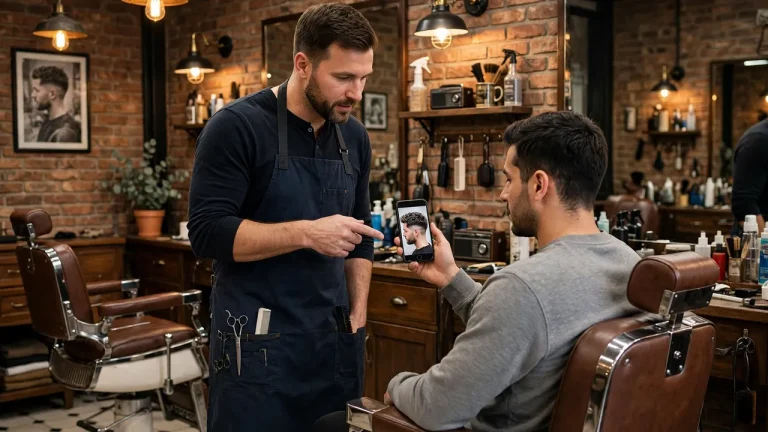
Walk into any barbershop and you will hear the same conversation play out in the chair. A client shows a photo, and the barber has to translate that photo into a plan for a real head of hair. Most of the time, the plan hinges on one call: scissors or clippers. Get it right and the haircut almost builds itself. Get it wrong and no amount of product will fix the shape, because the shape was never there.
Here is the practical answer. Scissors win when you want texture, movement, medium to long length, or a cut that still looks good weeks later. Clippers win when you want a short, sharp, uniform result with almost zero daily styling. Plenty of haircuts use both tools in one appointment, and knowing which sections get which tool is what separates a decent cut from a great one.
What a Scissor Cut Actually Gives You
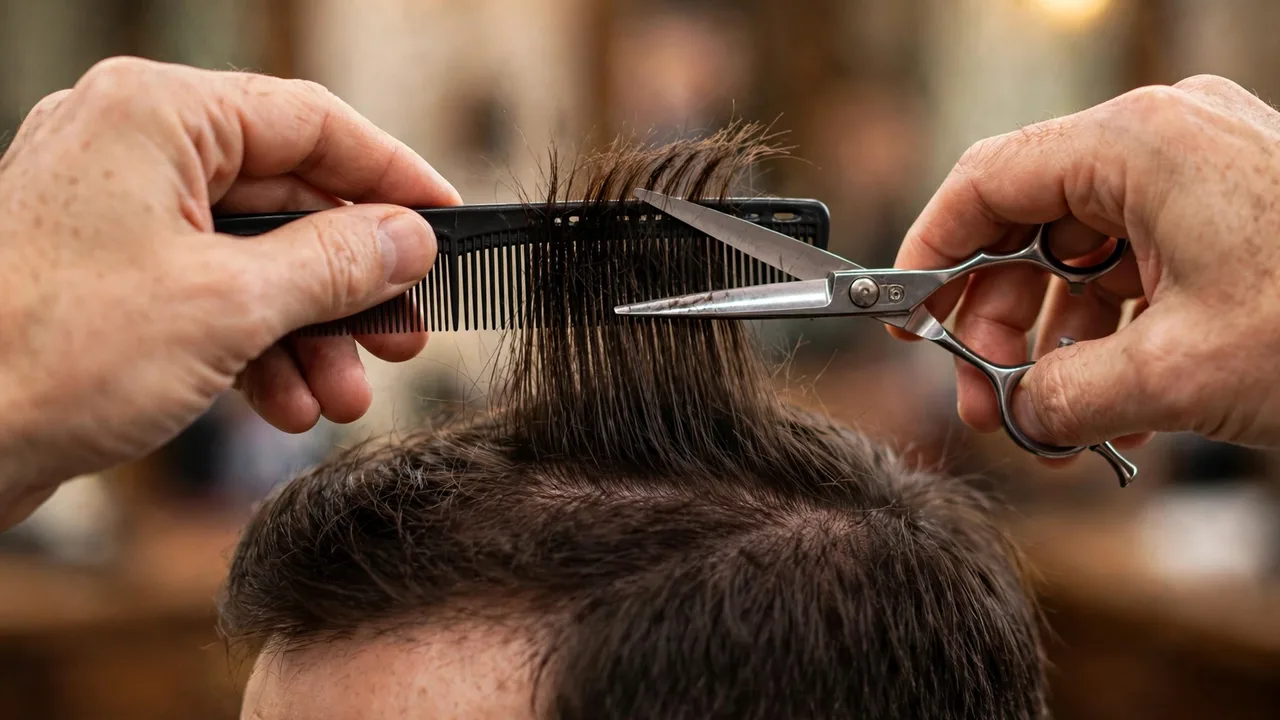
A scissor cut is exactly what it sounds like. The barber cuts with shears, usually working over a comb, and builds the shape section by section. There is no guard setting the length for the whole head. Every snip is a decision, which is why the result follows your head shape and hair behavior instead of fighting them.
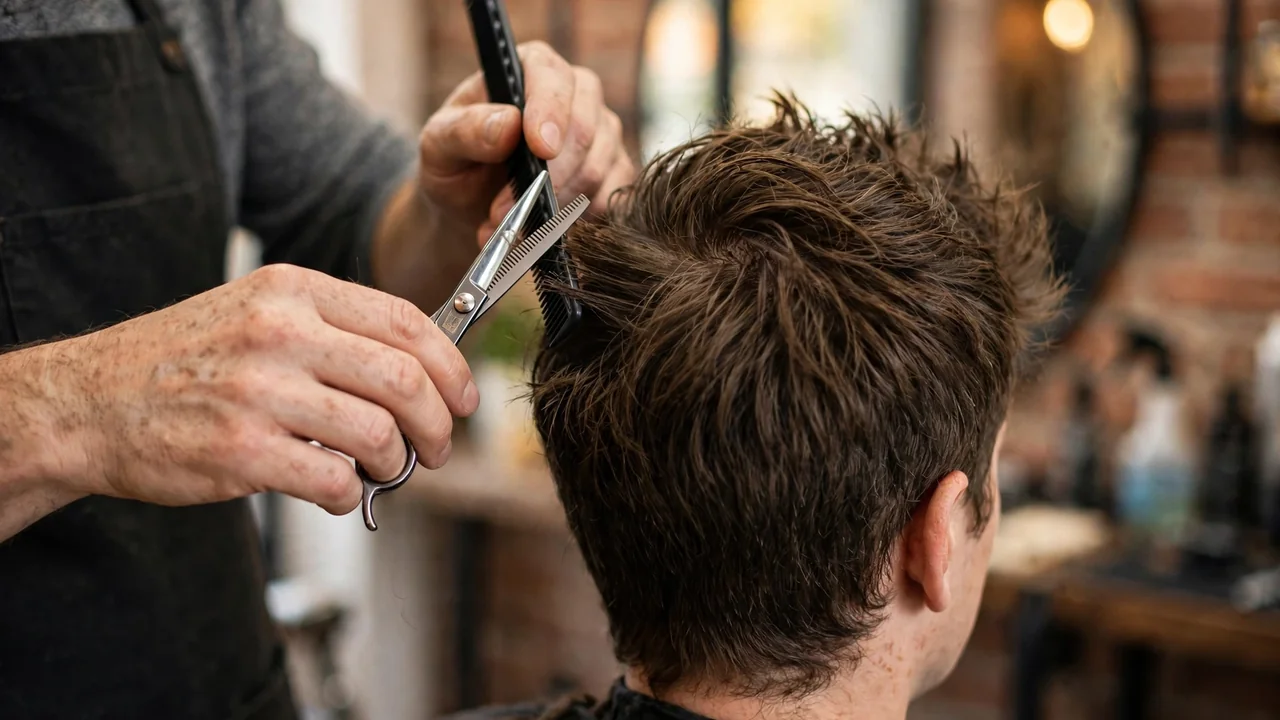
This is the default approach for most classic men’s styles. If you have ever admired a cut that looked natural, like the hair just grew that way but better, there is a strong chance scissors did the heavy lifting.
Length and Layers You Can Style
Scissors are the only tool that can create true layers. A guard cuts every hair it touches to the same length, while shears can leave the top longer than the corners and add texture through the fringe. That variation is what makes a quiff stand up with volume or an Ivy League haircut lie neatly to the side. Without layers, those styles fall flat no matter how much product you use.
Length retention is the other big advantage. Clippers struggle to keep hair longer than about an inch while still looking clean, because long hair feeds unevenly through the blades. Scissors have no such limit, so if you want three inches on top with tidy sides, the shears are doing that work.
How It Grows Out
A scissor cut grows out more gracefully than a clipper cut. Because the shape was built with gradual transitions, the hair keeps a decent silhouette as it gets longer, and the cut usually still looks presentable at week five or six. The ends soften rather than sticking straight out.
That softer grow-out means you can stretch appointments further apart. Many men with scissor cuts visit the barber every four to six weeks and still look sharp in between. A tight clipper fade, by contrast, can lose its edge in two weeks because the short sections reveal growth so quickly.
What a Clipper Cut Actually Gives You
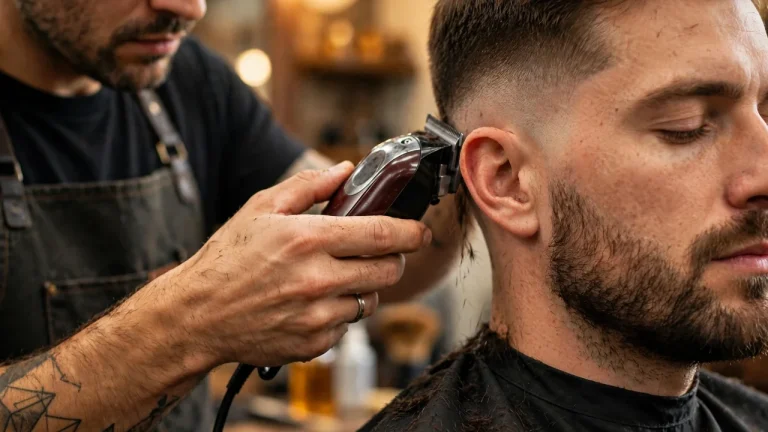
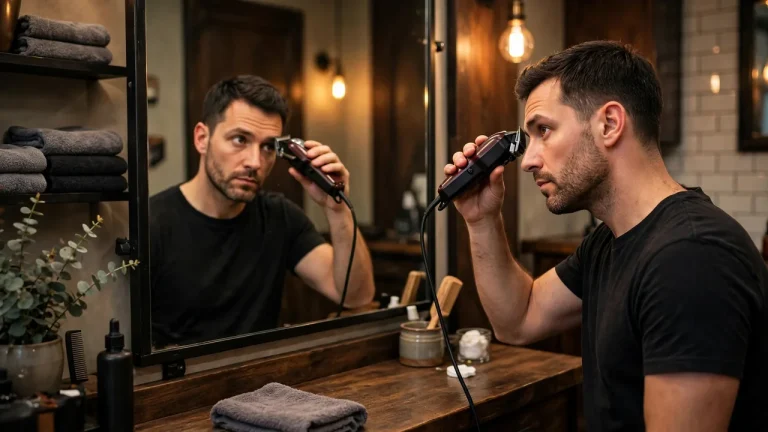
A clipper cut uses electric clippers, usually with a guard, to take every section to one consistent length. It is fast, precise and repeatable. The same guard on the same head produces nearly the same result every time, which is why clippers dominate short styles.
Clippers also work freehand or over a comb for blending, so a clipper cut does not always mean one length all over. But the defining trait is uniformity. The tool sets the length, not the barber’s eye, and that consistency is exactly what some styles demand.
The Sharp Uniform Finish
When the goal is crisp and clean, nothing beats clippers. A buzz cut at one length all over has a stark, deliberate look that scissors cannot reproduce, because hand cutting always leaves slight variation. Fades are another clipper specialty, since the smooth gradient from skin to length depends on guards stepping down in tiny increments.
The classic crew cut shows where clippers shine in a structured style. The sides get clipped short and tight, often with a fade, while the top stays just long enough to shape. That contrast is the whole identity of the cut, and it only works because the clipper sections are so uniform.
Where Clippers Fall Short
Clippers are honest tools, and their honesty has limits. They cannot create layers, so any style that needs internal texture has to bring scissors into the picture. They also cut every hair in a section to the same length, which can look blunt and heavy on thick hair, and oddly flat on fine hair.
The grow-out is the other trade-off. Every hair in a clippered section was cut to the same length, so they grow straight out from the scalp together. That is why a growing-out buzz can look stubbly and uneven after two or three weeks. Frequent touch-ups are the price of that crisp finish.
Scissor Cut vs Clipper Cut at a Glance
Most of the real differences come down to time in the chair, how the hair behaves afterward, upkeep and which styles each tool can build. The table below puts the trade-offs side by side.
| Factor | Scissor Cut | Clipper Cut |
|---|---|---|
| Time in the chair | Usually 30 to 60 minutes, since every section is shaped by hand | Usually 15 to 30 minutes, since guards set the length quickly |
| Finish | Soft, textured and natural with visible movement | Crisp, uniform and structured with clean lines |
| Best hair length | Medium to long, or any top with length to style | Short, from skin fades up to about an inch |
| Grow-out | Soft and gradual, still presentable at week five or six | Fast and obvious, loses its edge in two to three weeks |
| Styling at home | Usually needs product and a few minutes of effort | Almost none, towel dry and go |
| Barber skill needed | High, the result depends entirely on technique | Moderate, guards do much of the work |
| Typical price | Often higher, reflecting the time and skill involved | Often lower, especially for simple one-length cuts |

The pattern is clear. Scissors trade time and styling effort for versatility and a longer-lived shape. Clippers trade versatility for speed, precision and a wash-and-go routine. Neither column is all upside, which is why most barbers reach for both tools in a single appointment.
How Your Barber Answers Scissor Cut vs Clipper Cut
Watch a good barber work and you will notice the tool choice changes section by section, not just haircut by haircut. Scissors come out when the brief involves keeping length, building texture or blending transitions that a guard would make too abrupt. Clippers come out when the brief asks for a clean baseline, a tight fade or a uniform finish that has to look identical on both sides.
A typical appointment mixes the two without the client even noticing. The barber might clip the sides down to a number 2 guard for that crisp foundation, then switch to shears for the top, keeping three inches of length with layers through the crown. The neckline gets a final pass with the trimmer for a sharp outline. The client sees one haircut, but three different tools did three different jobs.
Hair type influences the call too. Thick, dense hair often needs scissors to remove bulk and create movement, because clippers alone leave it heavy and helmet-like. Curly hair is almost always a scissor job on top, because cutting curls to one even length removes the shape that makes curls look good.
The Scissor Over Comb Technique Explained
Scissor over comb is the signature move of the scissor cut, and it is the technique your barber uses on the sides and back whenever clippers would look too harsh. The barber lifts a section of hair with a comb and runs the shears along the teeth, trimming everything that sticks past. The comb acts like a custom guard, setting the length for that exact spot on that exact head.
What makes it special is control. A clipper guard sets one length for the whole side of the head, but a head is not flat. Scissor over comb follows the curves, taking a little more where the head bulges and a little less where it hollows, so the result hugs the skull. If you want to see the hand position, this scissor-over-comb tutorial walks through it step by step.
There is also clipper over comb, the faster cousin of this technique. The barber runs the machine over the comb instead of the shears, which sets length quickly on thick sides but gives up some of the softness that shears deliver. It works as a shortcut on coarse hair, though the hand-cut version looks more natural up close.
When the Technique Shows Its Best
Scissor over comb shines on the in-between lengths, cuts too long for a guard but too short for real layering. Think of a classic taper on the sides, a neat comb over with tidy edges, or the sides of a longer style that need to sit flat without looking faded.
It is also the go-to method for blending. Where a clippered section meets a scissored section there is often a visible line, and scissor over comb erases it by cutting the transition zone to a length between the two. It is one of the hardest skills to learn well, because the hand judges length by eye while the comb keeps moving.
What It Feels Like in the Chair
It feels slower than a clipper pass, and that is the point. The barber works in small sections, combing, lifting, snipping, combing again. You feel the comb against your scalp more than the scissors, and you hear the shears clicking steadily rather than the buzz of the machine.
The payoff shows up in the mirror. Run your hand over the side of your head after scissor over comb and it feels smooth with a soft taper, no harsh steps between lengths. The hand-cut version has a refinement that photos struggle to capture and people notice in person.
What to Tell Your Barber
The fastest way to get the right tool on your head is to describe the result, not the tool. Tell the barber what you want to see and how much work you will do at home, and let them pick the instrument. That said, it helps to know the words that get each version, because a vague request is how you end up with clippers when you wanted texture.
For a scissor-forward cut, say this: “I want to keep the length on top, around three inches, with some texture through it. Keep the sides neat but natural, no hard fade, and blend everything with scissor over comb. I style it with matte paste most mornings.” That covers length, texture, the sides, the blending method and your styling routine, and it quietly rules out clippers on top without forbidding anything.
For a clipper-forward cut, try this: “Take the sides down with clippers, a number 2 with a low fade, and keep the top short enough that I do not need product. Clean up the neckline and edges.” Short, specific and guard-numbered, which is the language clippers respond to. If you want clippers nowhere near the top, add one line: “No clippers on top, just the sides.” The electric clipper has a longer history than most clients realize, with guard-based cutting going back over a century, as the hair clipper entry documents.
How Often Each Cut Needs a Trim
Upkeep is where the two tools really separate. The table below gives honest maintenance windows. Your growth speed and how picky you are will shift these by a week or so in either direction.
| Cut Style | Main Tool | Trim Every | Daily Effort |
|---|---|---|---|
| Skin fade | Clippers | 2 to 3 weeks | Almost none |
| Buzz cut | Clippers | 2 to 4 weeks | Almost none |
| Crew cut | Both | 3 to 4 weeks | Minimal |
| Textured crop | Scissors | 4 to 5 weeks | Minimal |
| Ivy League | Scissors | 4 to 6 weeks | A few minutes with product |
| Longer layered cut | Scissors | 6 to 8 weeks | Regular styling |
The honest math: a clipper cut costs you more barber visits but almost no time in the bathroom. A scissor cut costs you more effort each morning but fewer appointments per year. Pick the trade that fits your life.
Who Should Skip Which
Skip the all-scissor route if you genuinely will not style your hair. A textured scissor cut with no product looks unfinished by day three, because the layers were designed to be activated by styling. If your morning routine is a towel and a door, clippers will serve you better than the finest shear work in the city.
Skip the tight clipper route if your scalp has features you would rather not advertise. Clippers at a low guard show everything: scars, moles, an uneven hairline, the exact shape of your skull. Scissors leave enough length to camouflage all of it. Men with thinning hair should be careful here, since a uniform clipper length across a thinning crown draws the eye straight to the scalp.
Also skip whichever tool your barber is weak with. A barber who fades beautifully but rarely picks up shears will give you a better clipper cut than scissor cut, and the reverse is true for a stylist who lives in scissor over comb. Ask what they enjoy cutting. The answer tells you which chair to sit in.
FAQs
Conclusion
Scissors and clippers are not rivals. They are two tools that solve different problems, and the best haircuts use each where it excels. Choose scissors when you want length, texture and a cut that ages gracefully. Choose clippers when you want sharpness, speed and a routine that asks nothing of you. When your barber reaches for both in one appointment, take it as a good sign, because the cut was planned around your head instead of around one tool. For more head-to-head style breakdowns, browse the guides at barbersgrooming.com before your next visit.